

TRIBUANA, THE THREE WORLDS, THEATRICAL WAY update 14 january 2021
 updated 14 January 2021, added lesson.
"To awaken and to cultivate the expression
of the Three Worlds: Thought, emotion, body "
My opinion: in Bali, the actors behave like servants. They serve a story (or "something"), which must be told (honoured). This means that the story is more important, more interesting, contain higher value than them. The story has already a life. The “hi-story” includes a better knowledge, wisdom, as well as a natural path (visible or invisible, comprehensible or incomprehensible) to follow.
In order to reveal this life (this mystery), the actors must mobilize all their resources.
The work consists to wake up, to cultivate and to unify the expression of the three worlds (body, emotion and thought) in order to arrive to a total expression through deep solution, clever/ intellectual, scientific and also sharply intuitive, analytical and global.
The history must be carrying the three natural, creative and generating ingredients:
1. It cultivates the intelligence in a creative way in the way of the harmony; therefore, it must make people more intelligent.
2. It gives a long life, its existence will last beyond its presence, longer than its physical life, beyond the emotion.
3. It must have the transforming (magical) effect, it transforms the actor the actress, the spectators and the surround (the world, "three worlds")
The field of exploration includes 21 lessons:
1. Penchak Silat or Silat (martial arts Indonesian = the art of survival). To foresee for this lesson, preferable to dress in white (trousers and white T-shirt if it is possible).
2. Tai Chi (of the movements carrying out to the conscience of the physical articulation and energy = chi)
3. Chi Kung (of the exercises physical and mental carrying out to the conscience of precious energy and very subtle which animates life and cosmos)
4. The work of percussions inspired by the Kodo (Japanese drum) to exert the work on rhythm, endurance, force, voices of the Three Worlds and the ritual. The instrument Kodo must be built.
5. Yoga: static positions, wakes up sensitivity which makes it possible to feel the interior impulse, which carries out an actor to the action and the realization.
6. Pranayama, exercises of breathing; inspiration and expiry of energy (to perceive and try out various kinds of energies);
7. Daily practice of some exercises of Taoist health. This exercise engages: the image, the movement, the sound and mental activities in link with the emotions, the organs of digestion, the 5 elements, the colours... etc).
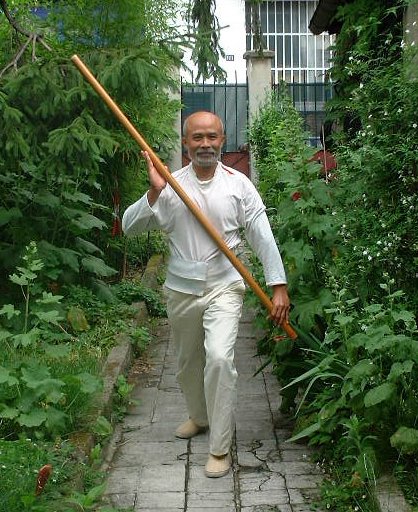
8. The work of the stick (Tongkat): the actors handle the stick and play with by repeating some precisely determined movements. The exercise of the stick is inspired by the martial arts for the aim of warming-up, health maintenance, work in group, meditation, and to awaken the feeling to be "ready to follow" (in the direction where the actor must serve, follows and gives life to a character or a story). The participant invited to bring with them a stick (of wood ) 35 mm in diameter, a length equal to that which separates the feet from the eyebrows (third eye).
9. Work with masks, stories which will be told individually or in group
10. Work with the musical instrument /percussion.
11. Work with the objects (props), like tools of expression or accessory to tell a history. (Puppet for example)
12. A work on improvisation, common creation, that relate with the work in/on a group. In this work 3 steps must be considered well: knowing/comprehending the participants, creating a common theatrical language and choosing/working on “subject” in common as “thing” more important to serve/to feed together.
13. A work in the group and on the group: serving the centre of the common interest of the group, it is necessary to know "the magic and mysterious thing which binds us together" which will give rise (realise) a story to tell, which will be then shared publicly. Aware of one common “thing/story” to develop; at the same time the actors remain open, alert, sincere, essential, therefore simple and direct. To understand/to comprehend "theatrically" is to be, is an action (with or without accessory) of a definite comprehension/interpretation that express in a living way. An actor who says "I understood", they are able to make it, to carry out their comprehension in acttion.
1
4. Kéchak: it is in the beginning a vocal chorus of all the villagers who take part in this dance/ trance of Bali, for goal to move away the contagious mortal diseases, negative/ destructive energy, the natural disaster who threaten to destroy the life of the people, animal or vegetal. This "chorus/ dance" makes it possible to the actors to work on the voice, on the collective rhythms, on the conscience and the energy of the group. It is a work on the harmonization, wakes up it cosmic energy of the group for cures, for the happiness of the life.
15. The actor is moved and danced by ethnic music, by singing songs from various countries, Ethnic song as theme of improvisation for movement and story to improvise.
16. A work on the sacred syllables - the sound – personal inner voice: to find, to give birth to a syllable each day. A syllable corresponds to a sound and is made up of a vowel and 1 to 4 consonants. Just as for the totem, the progression of work, the composition of the syllable, develops in such a way that the first day syllable will give birth to the syllable of the second day; the reality of the second day gives life to the syllable/reality of the third day, etc.
17. To meditate on (to contemplate) short sentences which are to be regarded as the crystal of the thought, fruits of contemplation. To reflect and exchange opinions, to discuss subject/ problem in a group, all these activities are the field where the thought can be cultivated and involved in order to produce a common theatrical language, a common creation based on common understanding/comprehension.
18. Story telling, story which are told by participants, or by myself, who will give place then to improvisations. To find a common language to explore and build together. To give life to a story consists in finding together the inner impulse of the story inside us, a work where the sharing is experienced.
19. Work on the "totem". A totem is a material composition which one develops by adding object/something to the composition each day. Totem will be presented and visited the last day of the workshop. The totem can be personal or collective. A totem can find its origin and initiated by a place or of an idea, which needs objects to become reality (and a definite place in the case if we work in the nature, outside).
20. When the spirit of the totem concentrates on a paper sheet, it becomes an image, a drawing and series of syllable, which is built with the passing days by daily adding a form or a line of colour and sound. It is what is called: the Hard Disk of the personal identity or Diskette.
22. Bayu Panah Tribuana, is inspired by Kyu-Do of Japanese ceremonial archery. This work needs bow (Japanese bow of bamboo ideally) and arrow and target, or we may use elastic to replace the present of bow. Students need to bring those instruments. a photo of it, klick here. There are some sequences of movement to be repeated every time in a ceremonial manner and intense concentration, there are 8 steps before releasing an arrow (8 hasetsu). Total awareness is to be developed. Video of my one-ma-show, Roma 1992 with kyu-Do, klick here

21. An introduction to ritual, by honouring the instruments of work, workspace and environment. A place where you work (DO JO/MARGA PURA) is regarded as a place where one cultivates a way of life/a path of life, a manner of being. Each one takes care the place of work, and share/ participate its maintenance; The preparation of the place will develop the work of group and awaken the sense of responsibility.
If the theatre is the "diamond of the life", its goal should be to crystalize the experience/ history /reality in expression, by awaken and cultivating the expression of the "three worlds" (body, emotions, thought), to follow the way of the harmony with nature, adapting their reality to the needs of the space, time and situation.
An actor (Tri Buana) must be in good health (tribuanicly), in way of harmony, in order to be able to animate the story (which animates them) and to offer it to the public that came to share the authentic account of the hi-story.
22. Bayu Panah Tribuana, is inspired by Kyu-Do of Japanese ceremonial archery. This work needs bow (Japanese bow of bamboo ideally) and arrow and target, or we may use elastic to replace the present of bow. Students need to bring those instruments. a photo of it, klick here. There are some sequences of movement to be repeated every time in a ceremonial manner and intense concentration, there are 8 steps before releasing an arrow (8 hasetsu). Total awareness is to be developed. Video of my one-ma-show, Roma 1992 with kyu-Do, klick here
23. Questionnaire -Tribuana: working on expression (in writing) of three parts of life-time: Participants of Tribuana expression workshop are invited to fill a questionnaire, a shared information , personal, professional, short essential-characteristic CV, as far as your openness to be expressed/exposed.


PAST : (what are your ancestral heritage, c.v, education, important workshop being done, important accident, past important experiences);
PRESENT :(job for living, what are you doing now in present living-time, what do you like to explore among 27 "lessons");
FUTURE : (what are you like to be in the future, your dreams, your ideal goal in life .... have the courage and sincerity to express not being afraid or shy to write if your were able or not able to reach it).

PAST : (what are your ancestral heritage, c.v, education, important workshop being done, important accident, past important experiences);
PRESENT :(job for living, what are you doing now in present living-time, what do you like to explore among 27 "lessons");
FUTURE : (what are you like to be in the future, your dreams, your ideal goal in life .... have the courage and sincerity to express not being afraid or shy to write if your were able or not able to reach it).
The past will make you sure to be present, and the future will attrack the present, hopefully with joy.
To see in symbol Tribuana questionnaire, see this picture below.
Notabene: opening, offering, determine the entrance. What you get depend on your openness. Information transforms.

24. Personal dialoog ou multiloog with Tapa Sudana. The meeting is to share essence of experience, to find answer of personal problem, to pro-pose one's opinion, one's advise, one's parameter/reference of life, how to be or not to be, what to take what to ignore, to channel one's thought and action in a direction. A dialectique conversation, between 2 there are the third to develop together.
25. . Post-note tribuana. This field/lesson tribuana was born after Easter Retreat at Casa Natura Alpenise, Cima Grappa, Italia, 28 march-1 april 2013. Eventhough the workshop is finish already, i still open impression/question exchange, by mail, skype, Facebook, as participants wish. For exemple, klick here
To see in symbol Tribuana questionnaire, see this picture below.
Notabene: opening, offering, determine the entrance. What you get depend on your openness. Information transforms.
24. Personal dialoog ou multiloog with Tapa Sudana. The meeting is to share essence of experience, to find answer of personal problem, to pro-pose one's opinion, one's advise, one's parameter/reference of life, how to be or not to be, what to take what to ignore, to channel one's thought and action in a direction. A dialectique conversation, between 2 there are the third to develop together.
25. . Post-note tribuana. This field/lesson tribuana was born after Easter Retreat at Casa Natura Alpenise, Cima Grappa, Italia, 28 march-1 april 2013. Eventhough the workshop is finish already, i still open impression/question exchange, by mail, skype, Facebook, as participants wish. For exemple, klick here
26. Gerak nuraga/Nurani, Olah Nuraga, Gerak Pranatman, ... Microcosmic dance ? A video to see? please Klick.
This field to explore as lesson, as exercise, as ritual, as food, tribuana food, seems to me came from my past research in Jogyakarta, with Bengkel Teater W.S.Rendra, that time, 1970, Bengkel's actors called it "Gerak Indah" = "Artistic/beautiful movement" for the first groups, and then with Rendra's second group in Jogyakarta, Indonesia, we explored "Gerak Nurani", Inner voice movement. In my memories, may be i have introduced and have done exploration on this work in Athens, in an archeological ancient ruin, late afternoon before sundown, with tribuana participants. A strange looking man ( look like hermit) passed by, and stop in a distance watching us, and at the end of our "Gerak Nurani", he came to me, saying:" you should not do this movement here, you are lucky, not many people pass by here" .....he passed away mysteriously.
For this work space climate/ambience is important as part of the guide/parameter. Every participants will bloom their Atmic (Atman)-bud (/grain), in their own spring time. Spring time can be created together in space, time, situation and participants. To start this work , we need to initiate it from lesson 0. Prep. a kind of Zero state mind meditation. Zero vocabulary. is it possible? hmmm, I don't know, but we are marching toward it, to find a "way" in no way. Vegetarian is a step to maintain, and has been started before, to purify the fine inner impulse that open, spring from inner impulse into a posture, posture into movement, into voice, into image, into word .. sentences ... it is a sacred celebration, personal, or in a group. The 5 vows is useful for mastering the moment of action. The criteria of cosmic symphony is being formed at that very moment, in evolution, in togetherness with others around you. An astonish moment, flowing and being flowed by prana, pnefma, chi, ki of life. All criteria/vocabulary of dance are to be omitted.No more right nor wrong, beauty nor ugly, like nor dislike, .... so ...."that's it, tat twam asi.
27. Impro Tribuana 3 words, let spring 3 words just instantly without much thinking, and from that improvise a song, composing lyric and music; eventually it can grow into movement, dance; the work is how to find a natural link from one word to other word. The 2 words as parents (masculine and feminine, or yin and yang, or positive and negative electric charge) will produce link for/to arrive at 3rd word, and then the 3 will produce Koan, Hai Ku, poem, sentences, story. How to grow, to nurture, tu cultivate those 3 words in this fields/ garden/ lesson? KEKAYUN can be a guide.
https://www.youtube.com/watch?v=puPjfcayJCA
https://www.youtube.com/watch?v=hIUERM-qG8M
etc; can be found more by the 3 words above as key.
28. KEKAYUN, Tree of Sentence, Tracing how grows one's words into sentence, that mirroring oneself, that sentence has power to sentence the speaker and the listener. The master for this field/lesson is "the tree". Observe how tree grows as aware how one aware words flow from the mouth, grows mirroring it image with "what tree?", grows like mono-spinal tree ( christmas tree, cedar tree (etc. alike) or tree that wildly uncontrolled branching in all direction (banyan tree), free to grow its branches as light and space offer/attracts (banyan tree, etc alike).

 This work need a quiet peaceful mind in order to respect and honor the "will" of 1 word, 2 words, 3 words .....etc. Words can be considered as a living spirit, as mater can be brought into life (awaken the spirit of life) by an "actor", actor present to awaken a deadly mater, deadly body of human, puppet, object, mask, etc. To honor the meaning of a word, to taste its sounds that composed by....? the consonants and vowels in it. Here a turning point, a departure point one will deal with the magic of "spiritual way", that has been explored by many religion. Speaking about spirituality by the path of religion, it is a personal way. We see now in the beginning of the 3rd millennium, diversity of religions can not offer peace in a certain society, to live in community of diversity (like Indonesia 15000 islands with different ethnic, language, tradition, belief, religions, culture, ...) Look at around Jerusalem, with 3 religions, no peace that can last for ...... Then, following the path of "spirit" (Atman), how life comes in matter, from dead cell to living cell. Peace in a place and in one-self, demands many parameter as: appropriate climate, so the magic can occur. What is the other side of peace? When peace follows by war, war need guns sssssss ......Why advanced nations (rich, wealthy materially) keep producing weapons, even atomic, on this round earth of diversity? Why?
Exemple in making sentence:
" i want to go to a city ......etc"
" i want to go to a city that where I can find someone that ..... etc
" i want to go to a city that where I can find someone that teach me..... etc.
You see how the sentence grow, how the word comes to joint the written sentence........ ???
What are the need of the first word?
And a line of words chained as sentence already written (reality to grow), sentence (not yet finish/complete) will be completed .....
Kekayun, kekayon, a figure that the DALANG (puppeteer) dance/move/gives life on the screen of shadow play WAYANG, in the beginning of the shadow-show.


29. Gym Tribuana
For this work space climate/ambience is important as part of the guide/parameter. Every participants will bloom their Atmic (Atman)-bud (/grain), in their own spring time. Spring time can be created together in space, time, situation and participants. To start this work , we need to initiate it from lesson 0. Prep. a kind of Zero state mind meditation. Zero vocabulary. is it possible? hmmm, I don't know, but we are marching toward it, to find a "way" in no way. Vegetarian is a step to maintain, and has been started before, to purify the fine inner impulse that open, spring from inner impulse into a posture, posture into movement, into voice, into image, into word .. sentences ... it is a sacred celebration, personal, or in a group. The 5 vows is useful for mastering the moment of action. The criteria of cosmic symphony is being formed at that very moment, in evolution, in togetherness with others around you. An astonish moment, flowing and being flowed by prana, pnefma, chi, ki of life. All criteria/vocabulary of dance are to be omitted.No more right nor wrong, beauty nor ugly, like nor dislike, .... so ...."that's it, tat twam asi.
27. Impro Tribuana 3 words, let spring 3 words just instantly without much thinking, and from that improvise a song, composing lyric and music; eventually it can grow into movement, dance; the work is how to find a natural link from one word to other word. The 2 words as parents (masculine and feminine, or yin and yang, or positive and negative electric charge) will produce link for/to arrive at 3rd word, and then the 3 will produce Koan, Hai Ku, poem, sentences, story. How to grow, to nurture, tu cultivate those 3 words in this fields/ garden/ lesson? KEKAYUN can be a guide.
https://www.youtube.com/watch?v=puPjfcayJCA
https://www.youtube.com/watch?v=hIUERM-qG8M
etc; can be found more by the 3 words above as key.
28. KEKAYUN, Tree of Sentence, Tracing how grows one's words into sentence, that mirroring oneself, that sentence has power to sentence the speaker and the listener. The master for this field/lesson is "the tree". Observe how tree grows as aware how one aware words flow from the mouth, grows mirroring it image with "what tree?", grows like mono-spinal tree ( christmas tree, cedar tree (etc. alike) or tree that wildly uncontrolled branching in all direction (banyan tree), free to grow its branches as light and space offer/attracts (banyan tree, etc alike).


Exemple in making sentence:
" i want to go to a city ......etc"
" i want to go to a city that where I can find someone that ..... etc
" i want to go to a city that where I can find someone that teach me..... etc.
You see how the sentence grow, how the word comes to joint the written sentence........ ???
What are the need of the first word?
And a line of words chained as sentence already written (reality to grow), sentence (not yet finish/complete) will be completed .....
Kekayun, kekayon, a figure that the DALANG (puppeteer) dance/move/gives life on the screen of shadow play WAYANG, in the beginning of the shadow-show.

Kekayon (Bali),

Gunungan (Java)
29. Gym Tribuana
Gym tribuana is gymnastic that awaken and activate the basic 3 human body, energy, rhythm, voice and thought, mind, imagination , in movements, inspired by tai chi, Indonesian silat/kung fu, yoga, karate, kalary payat, all personal movement that spring from body needs, naturally, as we get up in the morning there are a natural need to do stretching, shaking, massage etc. Every morning can be different in variation.One part of movement can be repeated many time, aware of what part of your body being moved, what rhythm and sound pronounced, how long, speed, etc.Take care to enjoy the movement. at the end of the session can be ended by pray.Simply sit quiet, to feel sensation in the body, breathing, observing, how quiet you are, wandering the state of being, your mind, steady or agitate, ponder stillness. Every day is a bliss, amazing grace.
There are 240 gym tribuana in you tube , as offering I made, free morning offering, as in Balinese tradition, we make offering every morning.
Enjoy. The number of video is growing, smilingly.
Enjoy. The number of video is growing, smilingly.
klick link below :
https://youtu.be/r72BgAmnMCw tao 5 elements
https://youtu.be/mhyGlmCMOQs tai chi 4 cardinals
etc

Brahman signifies the imperishable supreme. The realm of the SELF is the pure clear liberated essence of ones being. To ACT is to be on the way of the manifestation of the creative process, which leads the invisible BEING to existence.
Inspired by Bhagavad Gita, song VIII, 3.
Tapa Sudana,
Montreuil, Sunday 17 July 2005
tribuana@wanadoo.fr
for the new text of Tribuana presentation please see another blog : http://theatretribuana.blogspot.com/
NEXT WORKSHOP:
10 - 22 July 2006 in Paris, contact Olivier Richard 33 1 46 07 08 10, email: artmetamorph@libertysurf.fr , time from 10H00-18H00, except 16 july 2006;
Athenes, from 11-14 june 2006, contact Sandra Mavroidis: sandralala9@yahoo.gr tel: 00302107628368.
22-27 august 2006 at teatro del Montevaso, Italia,s.p. Del Montevaso km 18 - 56034 Chianni (Pisa) tel e fax 0587 647617 : tel 333 - 8592986 / 338-9397192
contact: Francesca Pompeo & Enrico Pompeo. teatrodelmontevaso@montevaso.it
 TAPA SUDANA
tribuana@wanadoo.fr
Born in Denpasar, Bali, Indonesia : 21 September 1945, IM70, 70 kg.
Until 1974, his name: I Gede Sudana; From 1974 on, his name: I Gede Tapa Sudana.
Study : 3 years Faculty of mechanical engineering at Gajah Mada University, Jogyakarta.
3 years Academy of Film and Theatre in Jogyakarta, Indonesia
Theatre in Indonesia started in 1968: with Ikra Negara, Putu Wijaya, W.S.Rendra and SardonoW.Kusumo.
With Rendra: In Hamlet as Claudius, in Oedipus as Therisias, in Macbeth as Macbeth.
With Sardono: In 1973-74 Kechak creation at Teges, Bali; in 1974 Dance Theatre Mask: “La Sorcière de Dirah”, European tour.
Theatre: since 1974 living in Paris.
“La Legende du glacier”, “Les Gens du glacier”, theatre-dance-mask of Bali and Lötschental (Swiss) directed by Marcel Robert, Geneva.
“PATRA”, theatre-dance-mask of Bali, a creation with I Made Netra, Soegeng, Dewi, Jacques Fassola. Performed Balinese Mask dance with: I Made Djimat, Cristina Wistari, Made Gerindem, Ida Bagus Geria, Soegeng.
“Voyage Punta” Solo dance theatre mask of Bali. “Bayu”: performance with: mask dance, flute, sakuhachi, Silat (Indonesian Kung-Fu), Kyu-do.
“Oh Jerusalem” by Elisabeth Swadows in New York and Roma.
“Zarzuela” directed by Alain Maratrat.
“Les Rescapés de la Dernière Croisade” de Marco Horvat, directed by Michel Hart.
“Tabarin” de Geneviève Serreau, directed by David Esrig as actor, masked.
“Zat”, Sufi story directed by Ali Ihsan Kaleci.
“Arbre à Palabre”, story telling with Footsbarn theatre;
With Peter BROOK (1979-1991): “La Conference des Oiseaux and L’Os”, Carmen,
The Mahabharata, The Tempest.
“Das lied von der Erde” by G.Mahler, David Stern, Yoshi Oida.
« Il n’y a plus de Firmament » by Josef Nadj.
Assistant Director:
Actor-trainer for mask in “Oedipus” directed by Stavros Dufexis, in Madrid. (Jose Luis Gomez as Oedipus).
Musician and actor-trainer for mask in “Iketides” directed by Stavros Dufexis, Epidaurus and Athenes.
Film work (actor):
“Rapsodie en Jaune”, telefilm in Paris.
“Carmen”, “Mahabharata” by Peter Brook.
“Tang le onzième” by Dai Sijie.
“Prêt à porter “ by Robert Altman.
“J’ai faim” by Florence Quentin.
« Palais Royal », by Valérie Lemercier.
Intervention in theatrical creation with various company : Tour de Babel, Salamandre, Footsbarn theatre.
Teaching :
Since 1979, Tapa Sudana gives workshops on Balinese mask and movement.
He has created a work on expression of the “three worlds”(thought, emotions, body) through workshops in France, Greece, Italy, Switzerland, Spain, Amsterdam, Belgium, Bogotá, Venezuela.
This work includes: body work based on Tai Chi, Silat (Indonesian Kung Fu), Yoga, Ko Do, Kyu Do, Totem (object composition/construction, contemplation, ritual, the sacred), Ethnic Song, Tongkat (stick work developed by Tapa), I.Disk (design, mandala, sacred-syllable), Story telling, Mask, Improvisation, Contemplated text, Meditation, Taoist health exercises, Chi Kung, Kechak (Balinese voice rhythm, movement), Rhythm, Group work, Ritual. MONTREUIL, 6 dec 2005.
TAPA SUDANA
tribuana@wanadoo.fr
Born in Denpasar, Bali, Indonesia : 21 September 1945, IM70, 70 kg.
Until 1974, his name: I Gede Sudana; From 1974 on, his name: I Gede Tapa Sudana.
Study : 3 years Faculty of mechanical engineering at Gajah Mada University, Jogyakarta.
3 years Academy of Film and Theatre in Jogyakarta, Indonesia
Theatre in Indonesia started in 1968: with Ikra Negara, Putu Wijaya, W.S.Rendra and SardonoW.Kusumo.
With Rendra: In Hamlet as Claudius, in Oedipus as Therisias, in Macbeth as Macbeth.
With Sardono: In 1973-74 Kechak creation at Teges, Bali; in 1974 Dance Theatre Mask: “La Sorcière de Dirah”, European tour.
Theatre: since 1974 living in Paris.
“La Legende du glacier”, “Les Gens du glacier”, theatre-dance-mask of Bali and Lötschental (Swiss) directed by Marcel Robert, Geneva.
“PATRA”, theatre-dance-mask of Bali, a creation with I Made Netra, Soegeng, Dewi, Jacques Fassola. Performed Balinese Mask dance with: I Made Djimat, Cristina Wistari, Made Gerindem, Ida Bagus Geria, Soegeng.
“Voyage Punta” Solo dance theatre mask of Bali. “Bayu”: performance with: mask dance, flute, sakuhachi, Silat (Indonesian Kung-Fu), Kyu-do.
“Oh Jerusalem” by Elisabeth Swadows in New York and Roma.
“Zarzuela” directed by Alain Maratrat.
“Les Rescapés de la Dernière Croisade” de Marco Horvat, directed by Michel Hart.
“Tabarin” de Geneviève Serreau, directed by David Esrig as actor, masked.
“Zat”, Sufi story directed by Ali Ihsan Kaleci.
“Arbre à Palabre”, story telling with Footsbarn theatre;
With Peter BROOK (1979-1991): “La Conference des Oiseaux and L’Os”, Carmen,
The Mahabharata, The Tempest.
“Das lied von der Erde” by G.Mahler, David Stern, Yoshi Oida.
« Il n’y a plus de Firmament » by Josef Nadj.
Assistant Director:
Actor-trainer for mask in “Oedipus” directed by Stavros Dufexis, in Madrid. (Jose Luis Gomez as Oedipus).
Musician and actor-trainer for mask in “Iketides” directed by Stavros Dufexis, Epidaurus and Athenes.
Film work (actor):
“Rapsodie en Jaune”, telefilm in Paris.
“Carmen”, “Mahabharata” by Peter Brook.
“Tang le onzième” by Dai Sijie.
“Prêt à porter “ by Robert Altman.
“J’ai faim” by Florence Quentin.
« Palais Royal », by Valérie Lemercier.
Intervention in theatrical creation with various company : Tour de Babel, Salamandre, Footsbarn theatre.
Teaching :
Since 1979, Tapa Sudana gives workshops on Balinese mask and movement.
He has created a work on expression of the “three worlds”(thought, emotions, body) through workshops in France, Greece, Italy, Switzerland, Spain, Amsterdam, Belgium, Bogotá, Venezuela.
This work includes: body work based on Tai Chi, Silat (Indonesian Kung Fu), Yoga, Ko Do, Kyu Do, Totem (object composition/construction, contemplation, ritual, the sacred), Ethnic Song, Tongkat (stick work developed by Tapa), I.Disk (design, mandala, sacred-syllable), Story telling, Mask, Improvisation, Contemplated text, Meditation, Taoist health exercises, Chi Kung, Kechak (Balinese voice rhythm, movement), Rhythm, Group work, Ritual. MONTREUIL, 6 dec 2005.
 TAPA SUDANA
tribuana@wanadoo.fr
Born in Denpasar, Bali, Indonesia : 21 September 1945, IM70, 70 kg.
Until 1974, his name: I Gede Sudana; From 1974 on, his name: I Gede Tapa Sudana.
Study : 3 years Faculty of mechanical engineering at Gajah Mada University, Jogyakarta.
3 years Academy of Film and Theatre in Jogyakarta, Indonesia
Theatre in Indonesia started in 1968: with Ikra Negara, Putu Wijaya, W.S.Rendra and SardonoW.Kusumo.
With Rendra: In Hamlet as Claudius, in Oedipus as Therisias, in Macbeth as Macbeth.
With Sardono: In 1973-74 Kechak creation at Teges, Bali; in 1974 Dance Theatre Mask: “La Sorcière de Dirah”, European tour.
Theatre: since 1974 living in Paris.
“La Legende du glacier”, “Les Gens du glacier”, theatre-dance-mask of Bali and Lötschental (Swiss) directed by Marcel Robert, Geneva.
“PATRA”, theatre-dance-mask of Bali, a creation with I Made Netra, Soegeng, Dewi, Jacques Fassola. Performed Balinese Mask dance with: I Made Djimat, Cristina Wistari, Made Gerindem, Ida Bagus Geria, Soegeng.
“Voyage Punta” Solo dance theatre mask of Bali. “Bayu”: performance with: mask dance, flute, sakuhachi, Silat (Indonesian Kung-Fu), Kyu-do.
“Oh Jerusalem” by Elisabeth Swadows in New York and Roma.
“Zarzuela” directed by Alain Maratrat.
“Les Rescapés de la Dernière Croisade” de Marco Horvat, directed by Michel Hart.
“Tabarin” de Geneviève Serreau, directed by David Esrig as actor, masked.
“Zat”, Sufi story directed by Ali Ihsan Kaleci.
“Arbre à Palabre”, story telling with Footsbarn theatre;
With Peter BROOK (1979-1991): “La Conference des Oiseaux and L’Os”, Carmen,
The Mahabharata, The Tempest.
“Das lied von der Erde” by G.Mahler, David Stern, Yoshi Oida.
« Il n’y a plus de Firmament » by Josef Nadj.
Assistant Director:
Actor-trainer for mask in “Oedipus” directed by Stavros Dufexis, in Madrid. (Jose Luis Gomez as Oedipus).
Musician and actor-trainer for mask in “Iketides” directed by Stavros Dufexis, Epidaurus and Athenes.
Film work (actor):
“Rapsodie en Jaune”, telefilm in Paris.
“Carmen”, “Mahabharata” by Peter Brook.
“Tang le onzième” by Dai Sijie.
“Prêt à porter “ by Robert Altman.
“J’ai faim” by Florence Quentin.
« Palais Royal », by Valérie Lemercier.
Intervention in theatrical creation with various company : Tour de Babel, Salamandre, Footsbarn theatre.
Teaching :
Since 1979, Tapa Sudana gives workshops on Balinese mask and movement.
He has created a work on expression of the “three worlds”(thought, emotions, body) through workshops in France, Greece, Italy, Switzerland, Spain, Amsterdam, Belgium, Bogotá, Venezuela.
This work includes: body work based on Tai Chi, Silat (Indonesian Kung Fu), Yoga, Ko Do, Kyu Do, Totem (object composition/construction, contemplation, ritual, the sacred), Ethnic Song, Tongkat (stick work developed by Tapa), I.Disk (design, mandala, sacred-syllable), Story telling, Mask, Improvisation, Contemplated text, Meditation, Taoist health exercises, Chi Kung, Kechak (Balinese voice rhythm, movement), Rhythm, Group work, Ritual. MONTREUIL, 6 dec 2005.
TAPA SUDANA
tribuana@wanadoo.fr
Born in Denpasar, Bali, Indonesia : 21 September 1945, IM70, 70 kg.
Until 1974, his name: I Gede Sudana; From 1974 on, his name: I Gede Tapa Sudana.
Study : 3 years Faculty of mechanical engineering at Gajah Mada University, Jogyakarta.
3 years Academy of Film and Theatre in Jogyakarta, Indonesia
Theatre in Indonesia started in 1968: with Ikra Negara, Putu Wijaya, W.S.Rendra and SardonoW.Kusumo.
With Rendra: In Hamlet as Claudius, in Oedipus as Therisias, in Macbeth as Macbeth.
With Sardono: In 1973-74 Kechak creation at Teges, Bali; in 1974 Dance Theatre Mask: “La Sorcière de Dirah”, European tour.
Theatre: since 1974 living in Paris.
“La Legende du glacier”, “Les Gens du glacier”, theatre-dance-mask of Bali and Lötschental (Swiss) directed by Marcel Robert, Geneva.
“PATRA”, theatre-dance-mask of Bali, a creation with I Made Netra, Soegeng, Dewi, Jacques Fassola. Performed Balinese Mask dance with: I Made Djimat, Cristina Wistari, Made Gerindem, Ida Bagus Geria, Soegeng.
“Voyage Punta” Solo dance theatre mask of Bali. “Bayu”: performance with: mask dance, flute, sakuhachi, Silat (Indonesian Kung-Fu), Kyu-do.
“Oh Jerusalem” by Elisabeth Swadows in New York and Roma.
“Zarzuela” directed by Alain Maratrat.
“Les Rescapés de la Dernière Croisade” de Marco Horvat, directed by Michel Hart.
“Tabarin” de Geneviève Serreau, directed by David Esrig as actor, masked.
“Zat”, Sufi story directed by Ali Ihsan Kaleci.
“Arbre à Palabre”, story telling with Footsbarn theatre;
With Peter BROOK (1979-1991): “La Conference des Oiseaux and L’Os”, Carmen,
The Mahabharata, The Tempest.
“Das lied von der Erde” by G.Mahler, David Stern, Yoshi Oida.
« Il n’y a plus de Firmament » by Josef Nadj.
Assistant Director:
Actor-trainer for mask in “Oedipus” directed by Stavros Dufexis, in Madrid. (Jose Luis Gomez as Oedipus).
Musician and actor-trainer for mask in “Iketides” directed by Stavros Dufexis, Epidaurus and Athenes.
Film work (actor):
“Rapsodie en Jaune”, telefilm in Paris.
“Carmen”, “Mahabharata” by Peter Brook.
“Tang le onzième” by Dai Sijie.
“Prêt à porter “ by Robert Altman.
“J’ai faim” by Florence Quentin.
« Palais Royal », by Valérie Lemercier.
Intervention in theatrical creation with various company : Tour de Babel, Salamandre, Footsbarn theatre.
Teaching :
Since 1979, Tapa Sudana gives workshops on Balinese mask and movement.
He has created a work on expression of the “three worlds”(thought, emotions, body) through workshops in France, Greece, Italy, Switzerland, Spain, Amsterdam, Belgium, Bogotá, Venezuela.
This work includes: body work based on Tai Chi, Silat (Indonesian Kung Fu), Yoga, Ko Do, Kyu Do, Totem (object composition/construction, contemplation, ritual, the sacred), Ethnic Song, Tongkat (stick work developed by Tapa), I.Disk (design, mandala, sacred-syllable), Story telling, Mask, Improvisation, Contemplated text, Meditation, Taoist health exercises, Chi Kung, Kechak (Balinese voice rhythm, movement), Rhythm, Group work, Ritual. MONTREUIL, 6 dec 2005.added lessson 14 january 2021
posted by tribuana tapa sudana | 1:33 AM

0 Comments:
Post a Comment
<< Home